

A fire-resistant cable (also referred to as a fire-rated cable) is not a cable that simply “does not burn.” It is designed to maintain circuit integrity under specified fire, time, and mechanical conditions.
These cables are commonly used in critical systems that need to remain operational during a fire, such as fire pumps, emergency lighting, smoke extraction systems, and fire alarm systems.
1. How Does a Fire-Resistant Cable Withstand Fire?
When exposed to high temperatures and flames, the insulation and sheath of a conventional cable may soften, melt, or thermally decompose, resulting in a loss of insulation performance.
Fire-resistant cables typically incorporate a dedicated fire-resistant insulation layer between the conductor and the primary insulation. Mica tape is one of the commonly used materials, while some cable designs use mineral insulation or ceramic-forming materials.
In mica-tape-based fire-resistant cables, the mica tape can retain its electrical insulating properties at high temperatures and act as a fire-resistant barrier, helping protect the conductor and maintain circuit integrity.
It is important to note that the high-temperature resistance of a material does not directly determine the fire rating of a finished cable. Overall performance also depends on the cable structure, material combination, manufacturing process, and test conditions.
2. Common Fire-Resistant Cable Structures
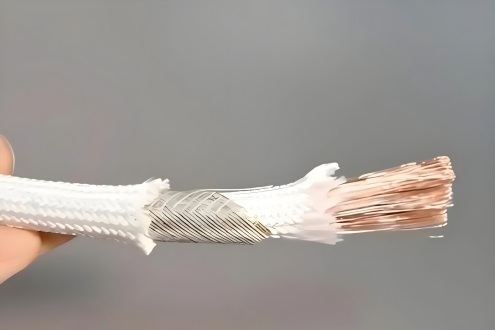
Fire-resistant cables can use different structures depending on their fire-resistance mechanism and application requirements.
Mica-tape-wrapped cables are a widely used solution. Mica tape is typically wrapped around the conductor before the insulation and sheath are applied. Performance depends not only on the properties of the mica itself, but also on the tape’s mechanical strength, flexibility, and wrapping performance.
Mineral-insulated cables generally use a metal sheath with an inorganic insulating material such as magnesium oxide (MgO). They offer excellent high-temperature resistance, but their flexibility and installation characteristics differ from those of conventional cables.
Other cable designs use ceramic-forming silicone rubber or similar materials. The appropriate solution depends on the cable application, required fire performance, installation environment, and manufacturing process.
3. Why Is Material Selection Important?
A fire-resistant cable is a system in which multiple materials work together.
The conductor carries electrical current, the fire-resistant layer provides insulation protection under fire conditions, the primary insulation provides electrical insulation during normal operation, and the sheath provides mechanical and environmental protection.
For cables using mica tape, important considerations include high-temperature resistance, electrical insulation performance, tensile strength, flexibility, and wrapping integrity. Tape dimensions and the wrapping method also need to be compatible with the specific cable structure and manufacturing process.
Therefore, material selection should consider not only technical specifications, but also actual processing performance.
4. Matching Materials with the Manufacturing Process
The same material can perform differently depending on the equipment, line speed, tension, and processing conditions.
For this reason, selecting materials for fire-resistant cables requires consideration of the conductor design, wrapping method, overlap, insulation extrusion process, and final product requirements.
Consistent material dimensions, mechanical properties, and processing characteristics are important factors in maintaining production consistency.
5. Fire-Resistant Cable Materials from ONE WORLD
ONE WORLD specializes in cable materials and supplies cable manufacturers with a range of materials for fire-resistant cable applications, including Phlogopite Mica Tape and ceramic silicone rubber.
We look beyond material specifications and also consider the cable structure, production equipment, and processing conditions when discussing material requirements with customers.
ONE WORLD and cable equipment manufacturer LINT TOP are both part of HONOR GROUP. LINT TOP has extensive experience in the development and manufacturing of cable production equipment, covering processes such as wire drawing, stranding, cabling, braiding, armoring, and extrusion.
Our understanding of both cable materials and cable manufacturing equipment allows us to discuss material requirements from both the material-performance and processing perspectives. This provides practical support to fire-resistant cable manufacturers in material selection, sample testing, and production applications.
Conclusion
A fire-resistant cable is more than simply adding a “fire-resistant material.” Its performance is the result of the interaction between materials, cable structure, and manufacturing processes.
For cable manufacturers, appropriate material selection and consistent processing are important foundations for achieving the required cable performance and production consistency.
ONE WORLD continues to provide a range of cable materials and related technical support based on the practical needs of cable manufacturers.
Post time: Aug-31-2026