

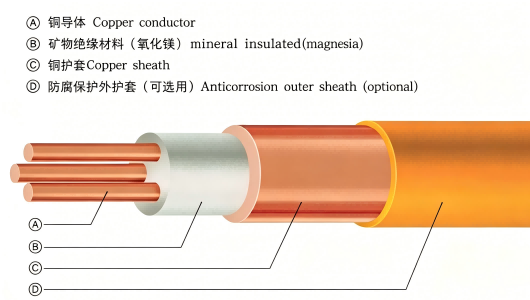
Mineral Insulated Cable (MI Cable) is a high-performance fire-resistant cable based on a fully inorganic cable materials system. Unlike conventional cables that rely on polymer insulation materials such as PVC, XLPE, and LSZH, MI cable is constructed using a copper conductor, a seamless copper sheath, and magnesium oxide (MgO) inorganic insulation material as its core structure. This material system fundamentally determines its stable performance under high-temperature and fire conditions.
From the perspective of cable materials development, inorganic material systems effectively eliminate the issues of decomposition, melting, and toxic smoke release that occur in organic materials under elevated temperatures. This makes MI cable an important solution for fire-resistant cables, high-temperature cables, and critical power system cable materials.
Material Structure and Composition
The performance of MI cable is primarily determined by its core cable materials system. The conductor is made of high-purity copper conductor, which provides excellent electrical conductivity and low resistance, making it a key component of power cable materials.
The insulation layer uses magnesium oxide (MgO insulation), a typical inorganic cable insulation material with a melting point above 2800°C. It maintains stable dielectric performance even under extreme temperatures, serving as the core material enabling fire resistance.
The outer layer consists of a seamless copper sheath, which provides mechanical protection and corrosion resistance. It also offers excellent thermal conductivity and electromagnetic shielding (EMI shielding) performance. In addition, the copper sheath can function as a grounding conductor, simplifying system design and improving operational reliability.
Fire Performance and Material Advantages
Under fire conditions, differences in material systems become critical. Traditional polymeric cable materials typically begin to thermally decompose or fail at temperatures between 300°C and 500°C, releasing smoke and hazardous gases.
In contrast, MI cable is based on an inorganic insulation system, and can maintain electrical integrity under direct flame exposure at approximately 950°C. It is capable of continuous operation for over 90 minutes, meeting international fire resistance standards such as BS 6387 and IEC 60331.
Meanwhile, its non-combustible cable materials do not burn, do not produce smoke, and do not release toxic gases, making MI cable a typical solution for fire survival cable materials widely used in emergency power supply and fire protection systems.
Material-Based Advantages and Challenges
From a cable materials perspective, MI cable offers intrinsic fire resistance, high current-carrying capacity, and long service life (typically 40–60 years). It is suitable for high-temperature, humid, and hazardous environments.
However, due to the large usage of copper materials and magnesium oxide insulation (MgO insulation), the overall material cost is higher than that of conventional cable systems. In addition, the fully inorganic structure results in higher rigidity, which places stricter requirements on cable installation, bending performance, and termination sealing processes.
Flexible MI cable designs can improve installation performance, but they also increase material and manufacturing complexity.
Typical Applications
Due to its excellent fire-resistant cable material performance, MI cable is widely used in high-rise building fire protection systems, rail transit infrastructure, large-scale public facilities, and petrochemical environments with high temperature and flammable risks.
In these applications, the stable performance of its cable materials system ensures continuous power supply under fire or extreme conditions, making it a critical solution for essential load power systems.
Conclusion: Trends in Cable Materials Development
From the perspective of cable materials development trends, MI cable represents a major shift from organic insulation materials to inorganic insulation materials.
For cable material suppliers, capabilities in controlling the purity, particle size distribution, moisture resistance, and flow properties of magnesium oxide (MgO insulation), as well as stable supply of copper conductor and copper sheath materials, will be key competitive factors in the high-end fire-resistant cable materials market.
We continue to focus on and provide related cable materials solutions, supporting customers in the application of MI cable and other high-performance fire-resistant cable systems.
Post time: Apr-29-2026