

The cable shielding layer plays an important role in power and communication cables, primarily used to suppress external electromagnetic interference (EMI), prevent the electromagnetic field generated by the cable itself from affecting the surrounding environment, and reduce the impact of fault currents on the system.
In practical applications, the choice of shielding material depends on the cable’s operating environment, rated current-carrying capacity, and shielding performance requirements. Common shielding methods include copper wire braid shielding, copper tape lapped shielding, copper wire helically lapped shielding, aluminum alloy wire braid shielding, copper-clad aluminum wire braid shielding, and aluminum-plastic composite tape lapped shielding. To ensure the electrical continuity of the shielding layer and facilitate grounding, copper tape or aluminum-plastic composite tape lapped shielding typically incorporates one or more annealed copper wires longitudinally arranged as drain wires for connecting to grounding terminals.
Shielding Performance Comparison
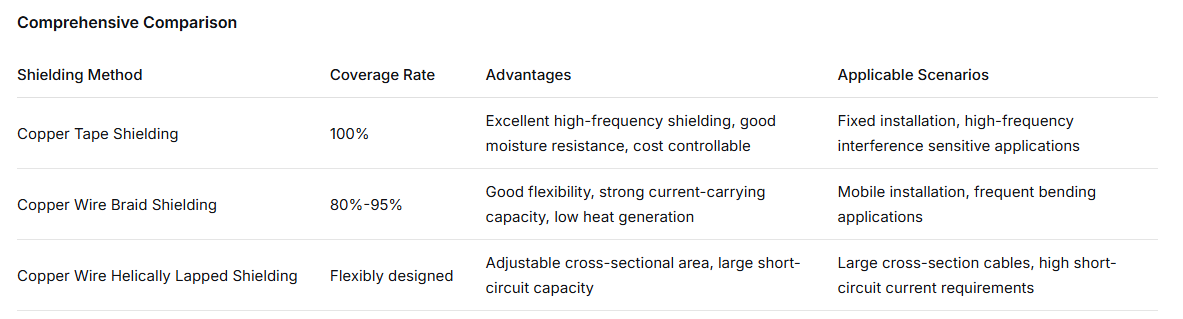
Copper tape shielding provides a continuous metal layer, achieving 100% full coverage, offering excellent shielding effectiveness against high-frequency electromagnetic waves, and providing good moisture resistance. However, copper tape has poor bending performance and may break under repeated bending, making it more suitable for fixed installation scenarios.
Copper wire braid shielding is composed of multiple strands of copper wire braided together, typically achieving 80%-95% coverage. Although there are small gaps, it offers good mechanical flexibility and strong bending resistance, making it suitable for mobile installation or applications requiring frequent bending. The multi-strand parallel structure provides a larger actual conductive cross-section under the same nominal cross-sectional area, resulting in stronger current-carrying capacity and lower heat generation.
Shielding Selection for Large Cross-Section Cables
For large cross-section cables (e.g., above 500 mm²) or applications with high short-circuit current requirements, the effective cross-sectional area of double-layer 0.12 mm copper tape may not meet the current-carrying requirements. In such cases, copper wire helically lapped shielding offers advantages—the cross-sectional area can be flexibly designed by adjusting the copper wire diameter and number of wires to meet large short-circuit capacity requirements.
For high-performance applications, a “copper tape + copper wire” composite shielding structure can be adopted, combining the advantages of high-frequency shielding and mechanical protection.
Customers should select shielding materials based on installation environment, interference type, and current-carrying capacity requirements. As a professional cable materials supplier, ONE WORLD provides high-quality copper wires, copper tapes, and various cable shielding materials, widely used in power cables, control cables, communication cables, and medium/low voltage water-blocking cables, offering customers reliable shielding performance and long-term operational assurance.
Post time: Feb-28-2026