

In modern communication networks, whether in overhead outdoor installations or indoor fiber optic cabling systems, the long-term stability of optical cables relies heavily on a critical cable reinforcement material—aramid yarn. With its lightweight properties, high tensile strength, and excellent environmental adaptability, aramid yarn is widely used in ADSS cables, FTTH fiber optic cables, indoor optical cables, and various communication optical cables, where it serves as a key tensile and structural reinforcement component, making it an essential part of modern optical cable materials.
1. Aramid Yarn: A High-Strength Cable Reinforcement Material
Aramid fiber is a high-performance aromatic polyamide fiber. In the optical cable industry, high-modulus aramid fibers are typically processed into aramid yarn, which is used to enhance the tensile strength and structural stability of optical cables.
Compared with traditional metallic reinforcement materials, aramid yarn offers both lightweight and high-strength characteristics. Its density is only about one-fifth that of steel wire, while its specific strength is significantly higher than that of steel. This allows it to reduce overall cable weight while still providing reliable mechanical support, making it an ideal optical cable tensile reinforcement material.
In addition, aramid yarn has a high elastic modulus and low elongation, effectively minimizing mechanical stress transferred to the optical fiber. This helps reduce micro-bending losses and signal attenuation. As a high-performance optical cable material, aramid yarn also offers good thermal stability, aging resistance, chemical corrosion resistance, and excellent insulation properties. It contains no metal components and therefore eliminates the risk of corrosion, making it suitable for long-term use in communication optical cables.
2. ADSS Cables: Aramid Yarn for Long-Span Aerial Installations
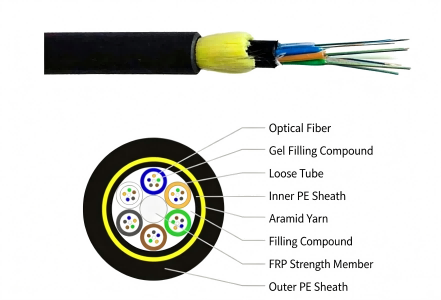
In the power communication sector, ADSS (All-Dielectric Self-Supporting) optical cable is one of the most important applications of aramid yarn. Since ADSS cables are installed along high-voltage power transmission lines over long spans, they require high-performance cable reinforcement materials with excellent tensile strength and insulation properties.
In ADSS cable structures, high-strength aramid yarn is typically used as the primary reinforcing element to withstand wind load, self-weight, and span tension. Compared with metallic support structures, aramid yarn is significantly lighter and does not generate induced current, making it more suitable for high-voltage power line environments.
By adjusting the structure and content of aramid yarn, ADSS cables can be designed for different spans and mechanical strength requirements. As a result, they are widely used in mountainous regions, river crossings, and long-distance power transmission communication systems.
3. Indoor Optical Cables: Improving Flexibility and Installation Stability
Compared with ADSS cables, indoor optical cables focus more on flexibility and bend resistance. In environments such as data centers, FTTH networks, and structured cabling systems, cables often undergo frequent bending and conduit installation, placing higher demands on cable reinforcement materials.
Typical indoor optical cables, such as GJPFJV cables, adopt a structure of “tight-buffered fiber + aramid yarn reinforcement layer + outer sheath”. In this structure, aramid yarn is used to absorb tensile forces and external mechanical stress, protecting the optical fiber and improving termination stability.
Thanks to its excellent flexibility and mechanical performance, aramid yarn effectively reduces damage caused by bending during installation and operation, ensuring long-term stability of indoor optical cables. As a result, it has become a key material in modern indoor optical cable systems.
Conclusion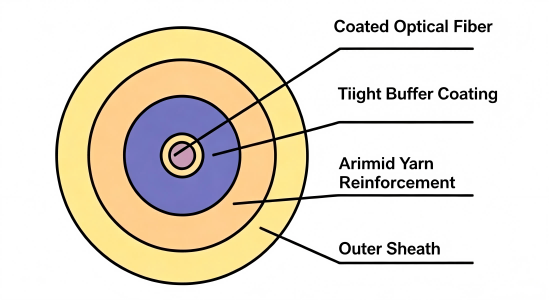
As a critical optical cable reinforcement material, aramid yarn is widely used in ADSS cables, indoor optical cables, FTTH cables, and various communication optical cable systems. With its lightweight structure, high tensile strength, excellent environmental resistance, and stable mechanical performance, aramid yarn plays an essential role in improving cable reliability and long-term operational stability. For optical cable manufacturers, selecting high-quality aramid yarn is a fundamental requirement to ensure cable performance and service life.
Post time: May-21-2026