

With the rapid global development of photovoltaic (PV) power generation systems, photovoltaic cables (PV cables)—as the critical components connecting PV modules, inverters, and combiner boxes—play a decisive role in the overall safety and service life of a solar power plant. Compared with conventional power cables, photovoltaic cables feature highly specialized structural designs and cable material selections.
1. What Is a Photovoltaic Cable?
A photovoltaic cable, also known as a solar cable or PV-specific cable, is mainly used in solar power plants, distributed photovoltaic systems, and rooftop PV installations. Common models include PV1-F and H1Z2Z2-K, which comply with international standards such as EN 50618 and IEC 62930.
Since PV cables are continuously exposed to outdoor environments, they must operate reliably under high temperatures, strong ultraviolet radiation, low temperatures, humidity, and ozone exposure. As a result, their requirements for insulation materials and sheathing materials are significantly higher than those of ordinary cables. Typical characteristics include resistance to high and low temperatures, excellent UV aging resistance, chemical corrosion resistance, flame retardancy, environmental friendliness, and a designed service life of 25 years or more.
2. Challenges to Cable Materials in Photovoltaic Applications
In real-world applications, photovoltaic cables are usually installed directly outdoors. For example, in European regions, the ambient temperature of PV systems can approach 100°C under sunny conditions. At the same time, the cables are subjected to long-term UV radiation, day–night temperature fluctuations, and mechanical stress.
Under such conditions, standard PVC cables or conventional rubber cables cannot maintain stable long-term performance. Even rubber cables rated for 90°C operation or PVC cables rated for 70°C are prone to insulation aging, sheath cracking, and rapid performance degradation when used in outdoor photovoltaic systems, significantly shortening the service life of the system.
3. Core Performance of Photovoltaic Cables: Specialized Insulation and Sheathing Materials
The key performance advantages of photovoltaic cables are primarily derived from their PV-specific insulation compounds and sheathing compounds. The mainstream material system used today is radiation crosslinked polyolefin, typically based on high-quality polyethylene (PE) or other polyolefins.
Through electron-beam irradiation, the molecular chains of the material undergo crosslinking, transforming the structure from thermoplastic to thermoset. This process substantially enhances heat resistance, aging resistance, and mechanical performance. Radiation crosslinked polyolefin materials allow photovoltaic cables to operate continuously at 90–120°C, while also providing excellent low-temperature flexibility, UV resistance, ozone resistance, and resistance to environmental stress cracking. In addition, these materials are halogen-free and environmentally compliant.
4. Structural and Material Comparison: Photovoltaic Cables vs. Conventional Cables
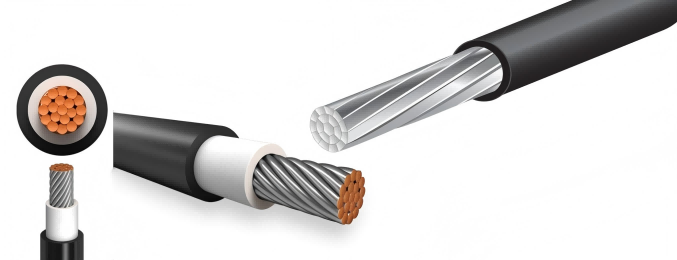
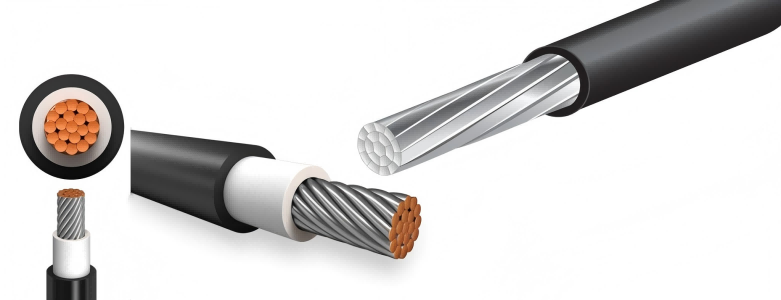
4.1 Typical Structure and Materials of Photovoltaic Cables
Conductor: Annealed copper conductor or tinned copper conductor, combining high electrical conductivity with corrosion resistance
Insulation Layer: Radiation crosslinked polyolefin insulation compound (PV cable–specific insulation material)
Sheath Layer: Radiation crosslinked polyolefin sheathing compound, providing long-term outdoor protection
4.2 Typical Structure and Materials of Conventional Cables
Conductor: Copper conductor or tinned copper conductor
Insulation Layer: PVC insulation compound or XLPE (crosslinked polyethylene) insulation compound
Sheath Layer: PVC sheathing compound
5. Fundamental Performance Differences Caused by Material Selection
From the conductor perspective, photovoltaic cables and conventional cables are essentially the same. The fundamental differences lie in the selection of insulation materials and sheathing materials.
PVC insulation and PVC sheathing compounds used in conventional cables are mainly suitable for indoor or relatively mild environments, offering limited resistance to heat, UV exposure, and aging. In contrast, the radiation crosslinked polyolefin insulation and sheathing compounds used in photovoltaic cables are specifically developed for long-term outdoor operation and can maintain stable electrical and mechanical performance under extreme environmental conditions.
Therefore, although substituting conventional cables for photovoltaic cables may reduce initial costs, it significantly increases maintenance risks and shortens the overall service life of the photovoltaic system.
6. Conclusion: Material Selection Determines Long-Term Reliability of PV Systems
Photovoltaic cables are not simple substitutes for ordinary cables, but specialized cable products designed specifically for photovoltaic applications. Their long-term reliability fundamentally depends on the selection of high-performance PV cable insulation materials and sheathing materials, particularly the proper application of radiation crosslinked polyolefin material systems.
For PV system designers, installers, and cable material suppliers, a thorough understanding of the material-level differences between photovoltaic cables and conventional cables is essential to ensuring the safe, stable, and long-term operation of photovoltaic power plants.
Post time: Dec-31-2025